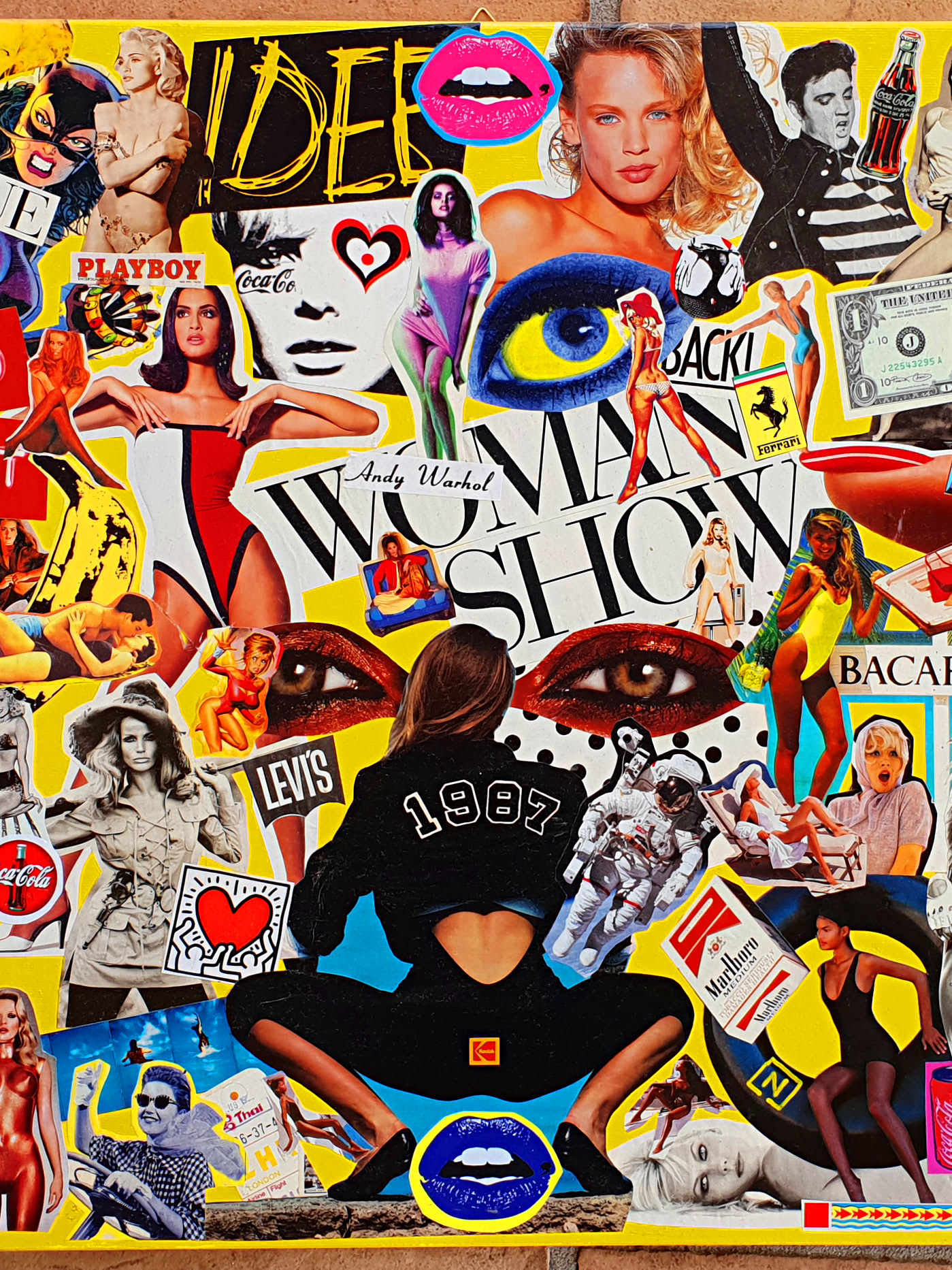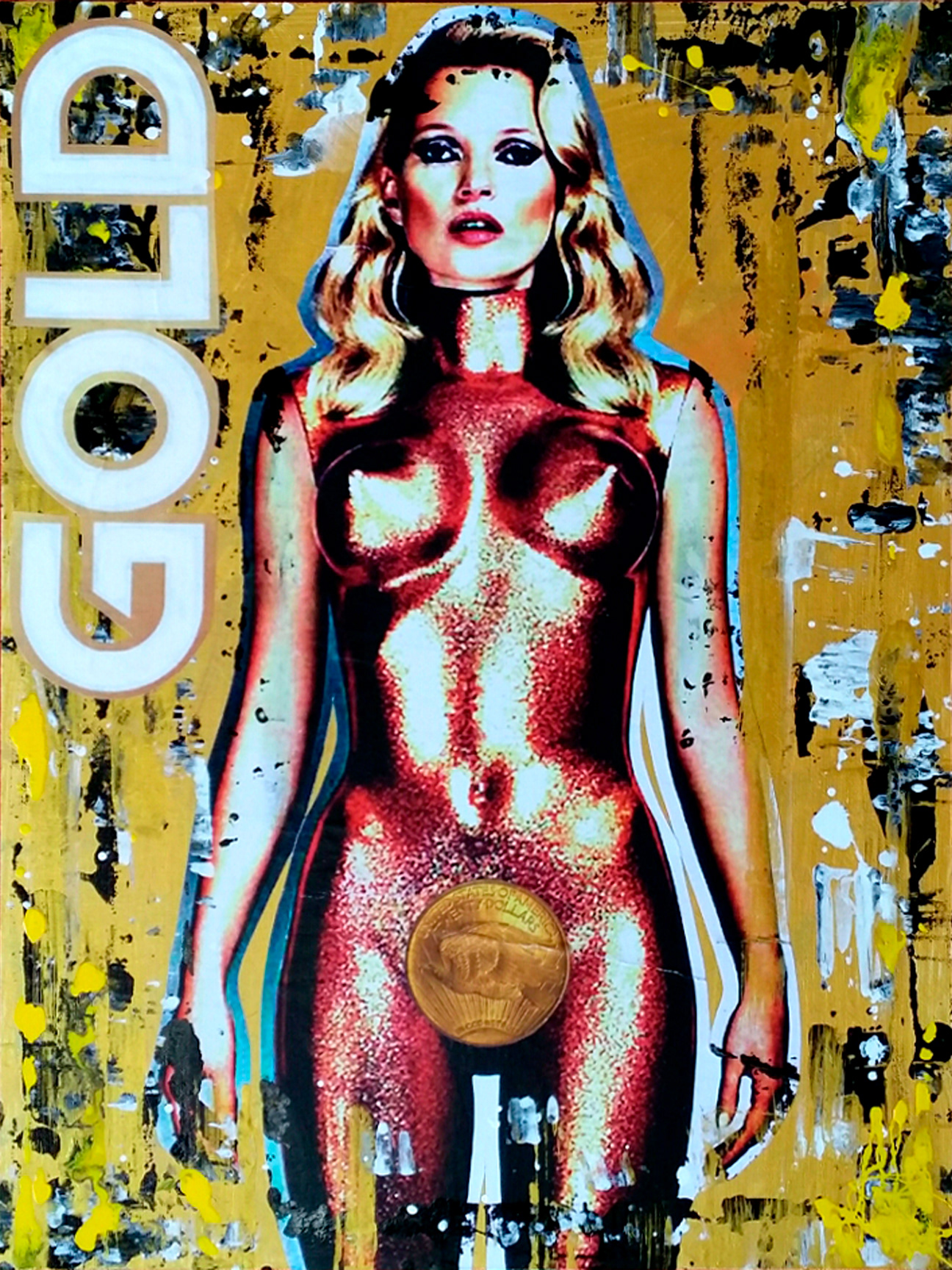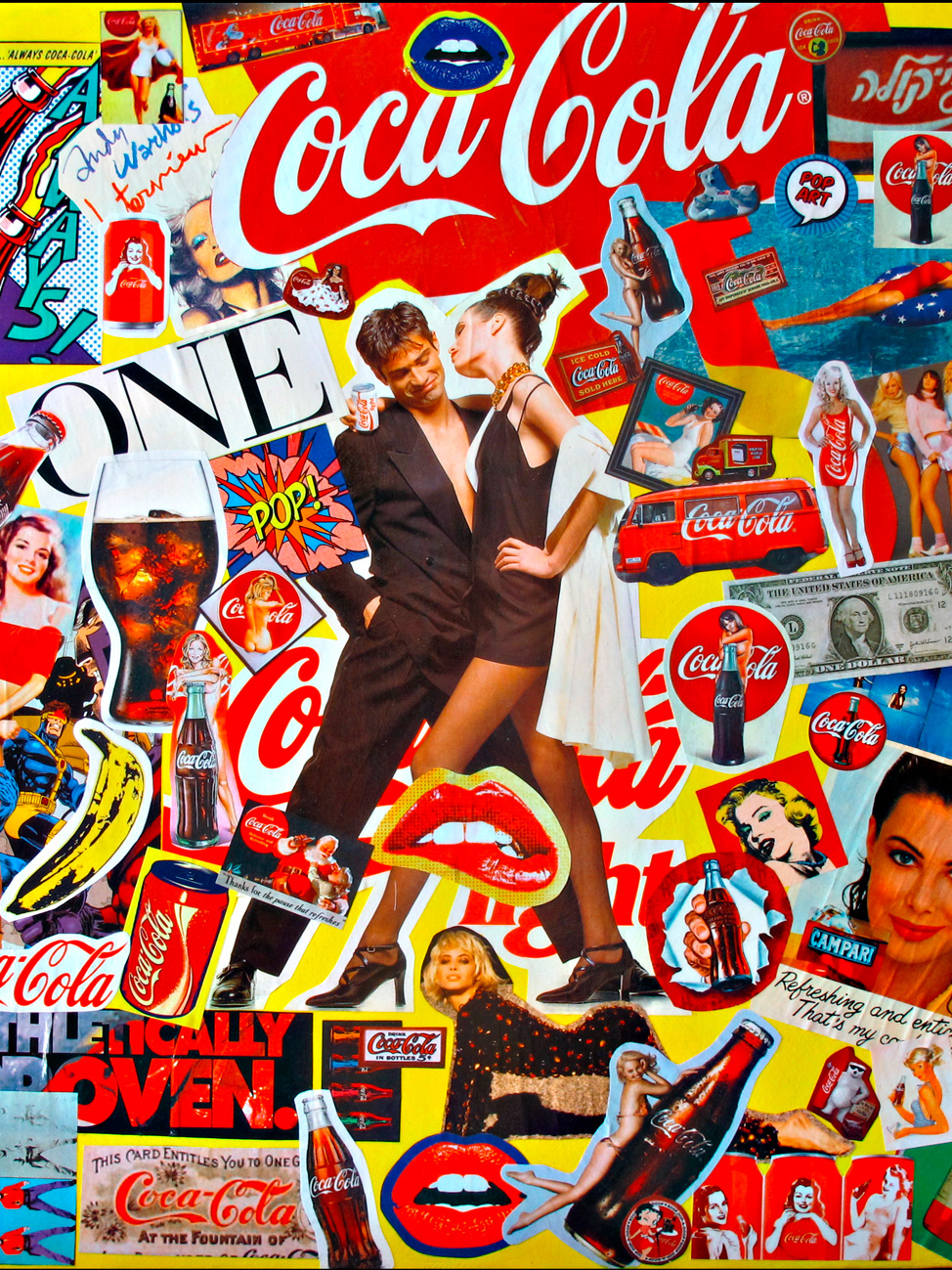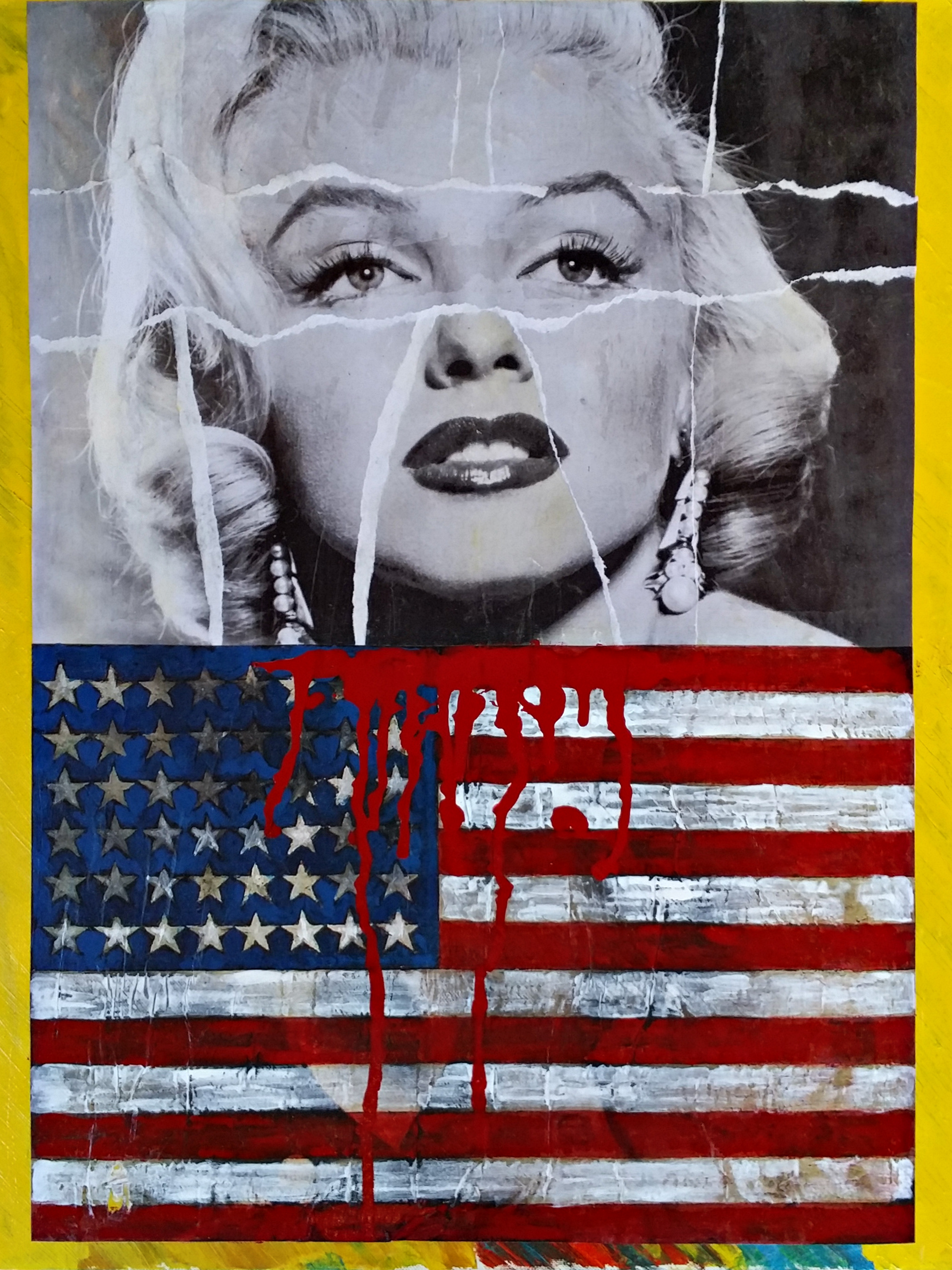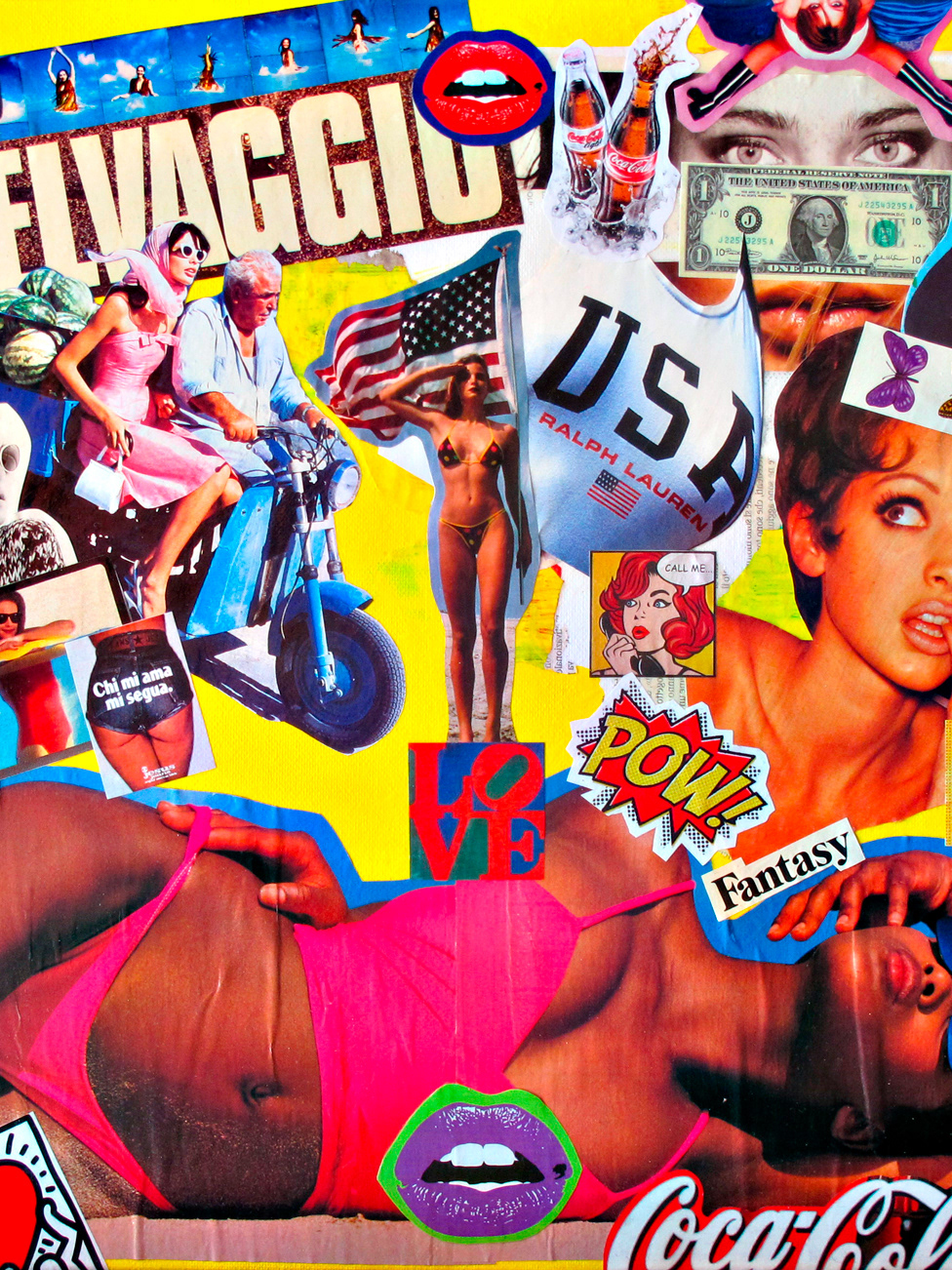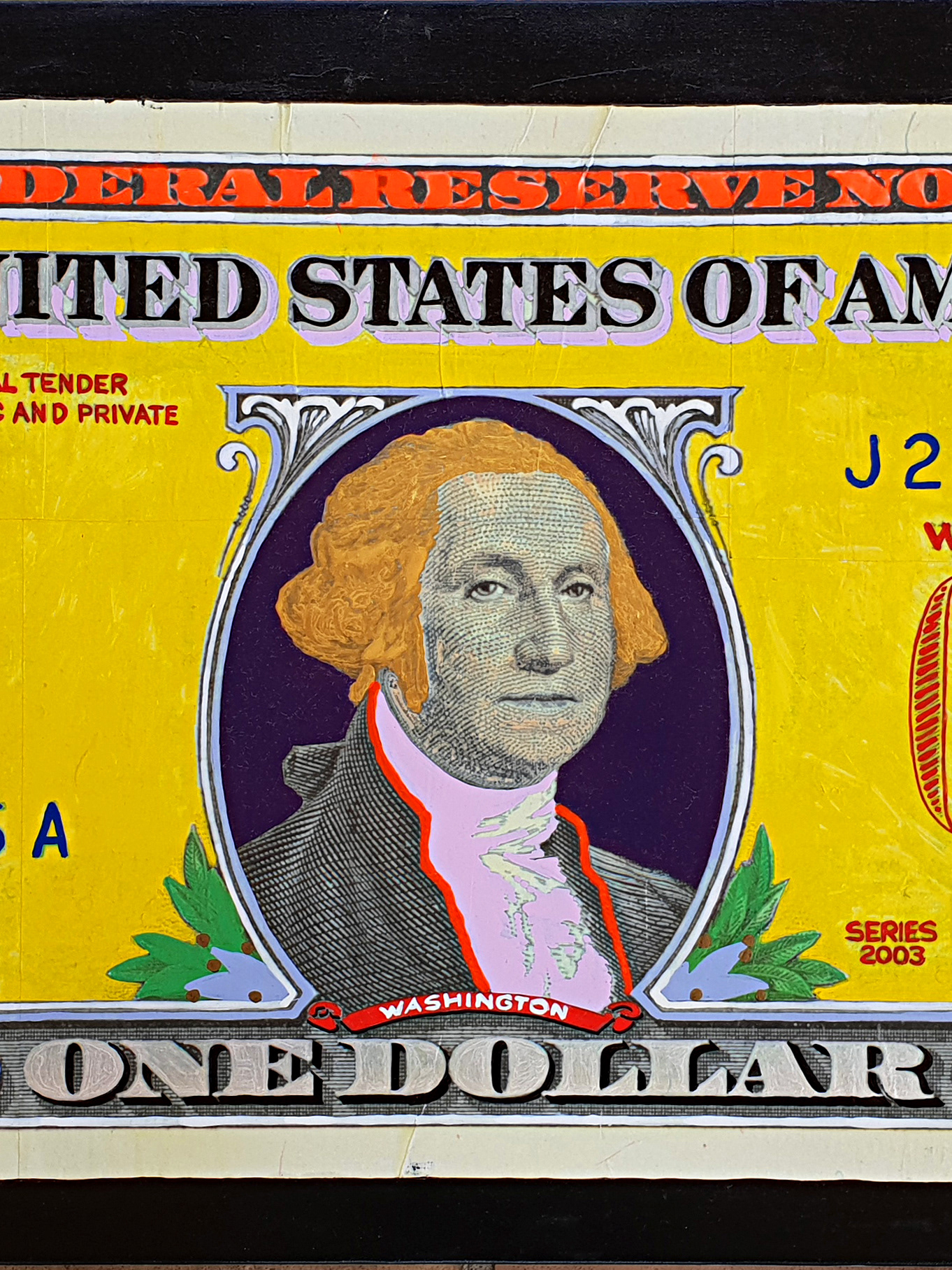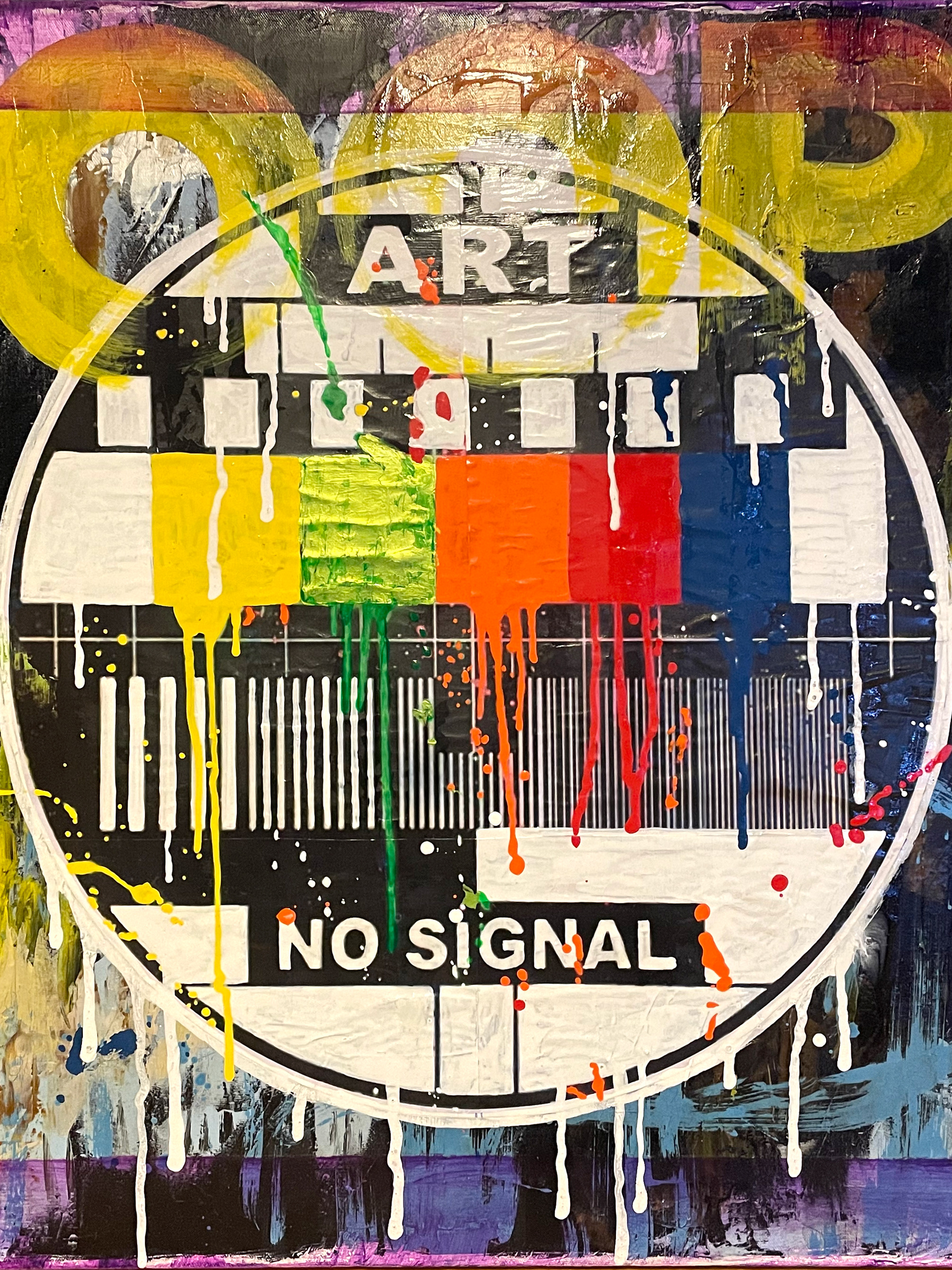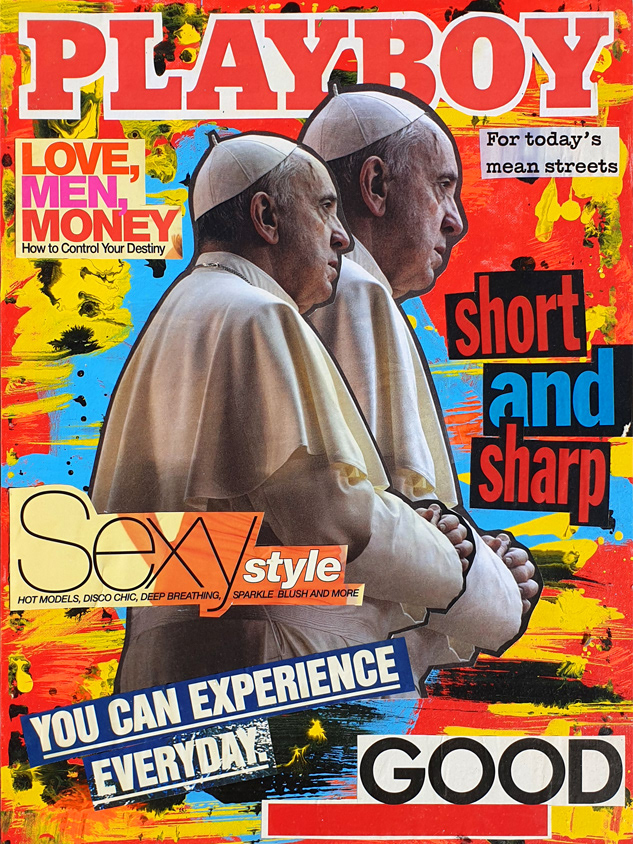
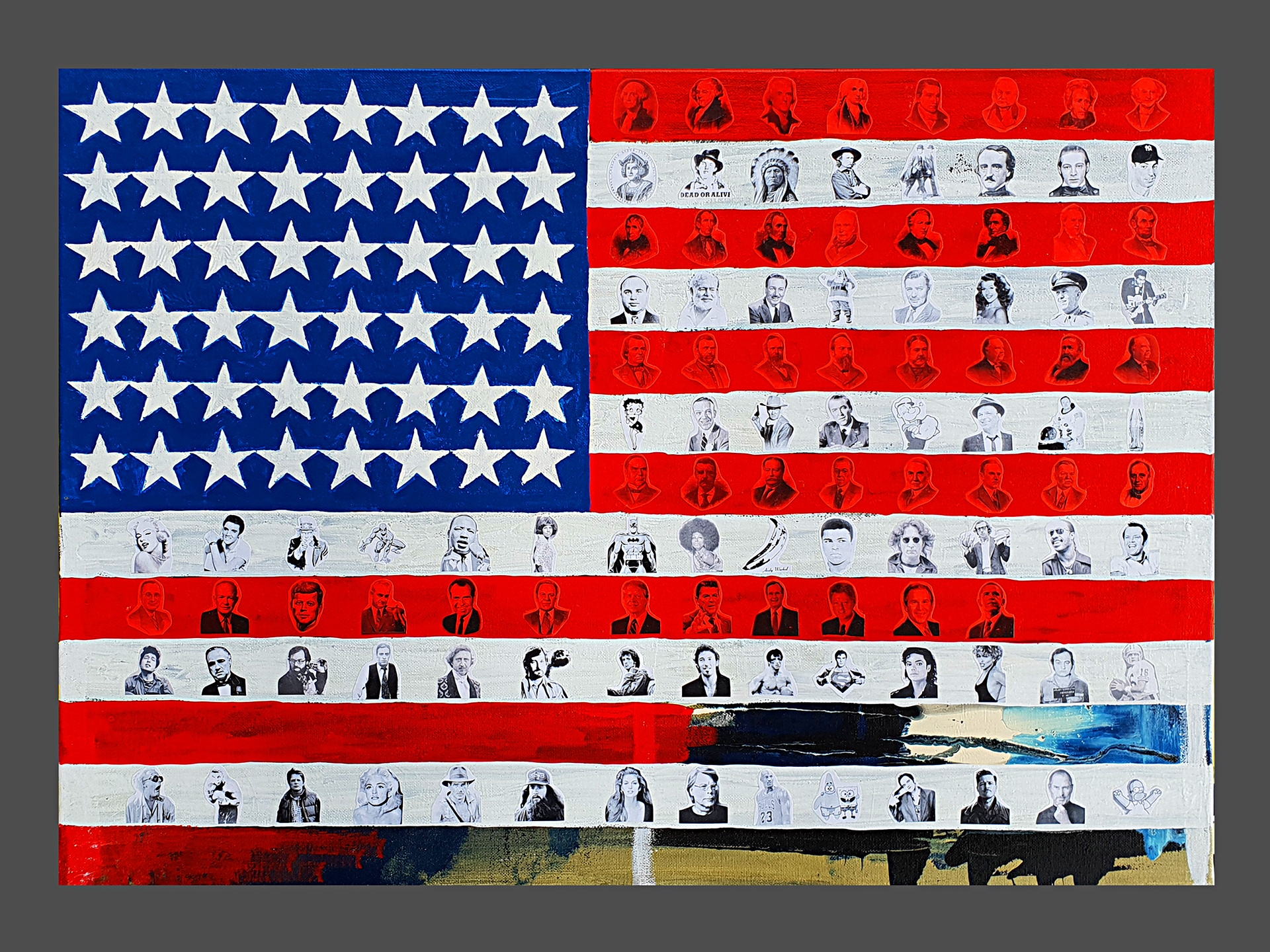
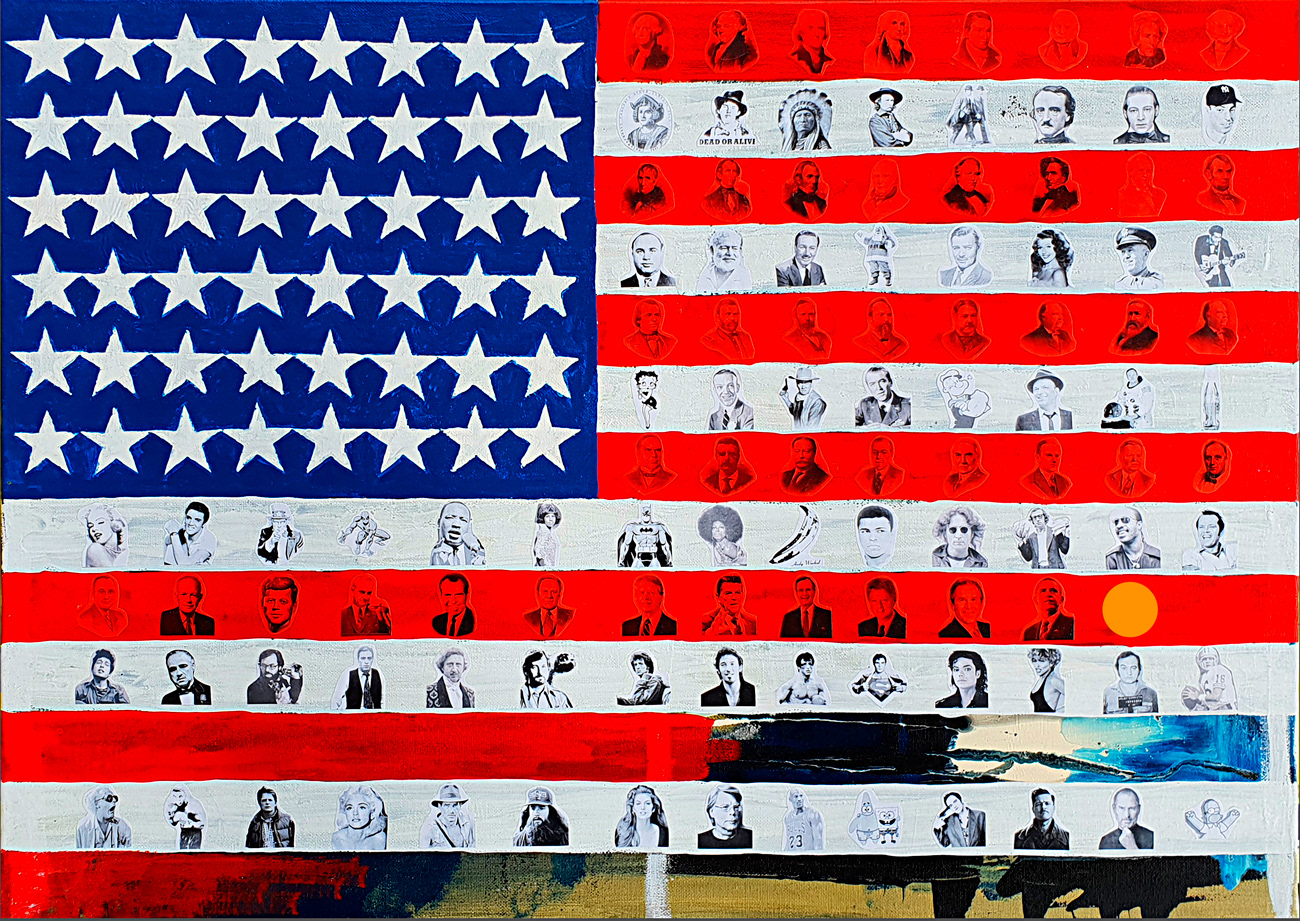
The American flag is not merely a national symbol; it becomes a narrative surface, a stratified iconographic field where institutional power and collective imagination alternate like solid and void within a shared cultural consciousness. The red stripes are dedicated to the Presidents of the United States, from George Washington to Barack Obama, marking the rhythm of official History. The white stripes, by contrast, function as a visual counterpoint: they host figures who have shaped American identity not through legislation, but through myth, spectacle, rebellion, consumption, literature, sports, and cinema. America has no medieval cathedrals or Renaissance stratifications upon which to anchor its visual memory. It is a relatively young civilization, and for this reason it has constructed its tradition in accelerated form, transforming individuals, characters, and even commercial brands into archetypes. Its mythology does not arise from ancient legend, but from news chronicles, the West, the culture industry, television, and advertising.
Christopher Columbus symbolically opens the narrative as a controversial founding figure — reinterpreted and debated. Soon after emerge the epic and tragic figures of the Frontier: Billy the Kid, Sitting Bull, General Custer. These characters embody the tension between conquest and resistance, between myth and tragedy, between nation-building and the erasure of preexisting cultures. American culture is born as iconographic conflict.
Then comes the era of invention and ingenuity: the Wright brothers, symbol of the obsession with progress that would become a defining trait of the United States. It is a country that imagines itself as the future, transforming technology into epic narrative.
With Edgar Allan Poe and Ernest Hemingway, we enter the construction of an autonomous literary voice — a writing that departs from European echoes to explore anxiety, minimalism, and the solitude of the modern individual. American literature emancipates itself and becomes style.
At the same time, cinema rises as the myth-making device par excellence of the twentieth century, gradually replacing traditional epic narratives. No longer mere entertainment, it becomes a complex semiotic apparatus capable of producing and sedimenting archetypal figures within collective consciousness. Rudolph Valentino, Clark Gable, Greta Garbo, John Wayne, James Stewart, Marlon Brando, Al Pacino, and Jack Nicholson are not simply performers, but catalysts of existential postures, behavioral matrices, anthropological models.
With Marlon Brando, acting undergoes a radical shift: the emergence of the Method breaks classical composure and introduces restless naturalism, fractured physicality, and unresolved tensions. The hero cracks, becoming opaque and ambiguous. Al Pacino and Jack Nicholson complete this metamorphosis, embodying the modern anti-hero — figures marked by neurosis, paranoia, ambition, and self-destruction, mirrors of a nation confronting postmodern disillusionment.
Hollywood, in this sense, is not only a cultural industry but an ideological machine and a factory of archetypes. With filmmakers such as Francis Ford Coppola, Steven Spielberg, and Quentin Tarantino, American cinema makes a further leap: from myth-making instrument to self-reflexive device. Coppola deconstructs the American Dream through family tragedy and mafia power; Spielberg alternates wonder and trauma, building an emotional pedagogy that interrogates historical memory and childhood as mythic territories; Tarantino performs citational surgery, dismantling and reassembling genres in a metatextual game that exposes the artificial nature of myth itself. These figures are not decorative presences but semiotic nodes in a cultural constellation, embodying the evolution of American imagination from founding epic to problematic narrative, from moral certainty to existential ambiguity.
If cinema constructs visual myths, music makes them corporeal — inscribing them into flesh, heartbeat, collective movement. Chuck Berry inaugurates an electric grammar that transforms the guitar into a device of youth emancipation; rock ’n’ roll becomes a subversive gesture, a generational fracture. Elvis Presley radicalizes performance, fusing African American roots with mainstream white culture and destabilizing racial and moral hierarchies. Aretha Franklin elevates the voice into an instrument of civil rights assertion; soul becomes a secular theology of dignity. Bob Dylan intellectualizes the popular song; Bruce Springsteen maps working-class America; Stevie Wonder fuses virtuosity and activism; Michael Jackson turns the music video into total artwork; Madonna theorizes identity mutation as aesthetic practice. American music does not simply accompany social change — it anticipates, accelerates, and dramatizes it.
Sport, too, transcends competition to assume epic-narrative function. Joe DiMaggio embodies restrained elegance; Muhammad Ali transforms the ring into political stage; Michael Jordan elevates basketball into global language and personal brand; Joe Montana symbolizes composure and leadership; Mike Tyson incarnates raw, unsettling force. Through them, America celebrates competition as destiny and excellence as vocation.
Hybrid icons born from the culture industry — Walt Disney, Coca-Cola, Uncle Sam, Santa Claus — dissolve the boundary between culture and commerce. America is the first nation to transform the brand into identity. Coca-Cola is not merely a beverage, but a color, an aesthetic, an exported idea of happiness.
The internal strength of the work lies in the coexistence of real and imaginary figures. Peter Parker, Bruce Wayne, Clark Kent embody responsibility and dual identity; Rocky Balboa, Rambo, Indiana Jones, Forrest Gump synthesize resilience and patriotism; Homer Simpson, SpongeBob, Marty McFly narrate domestic irony. In a young culture, the boundary between history and fiction is porous. Fictional figures carry the same symbolic weight as political leaders. Elvis Presley may shape national identity as much as a President; Superman may embody moral ideals more powerfully than constitutional doctrine.
The red and white stripes thus become a critical device: red as the color of power and political decision, white as the cultural space where desires, contradictions, dreams, and collective traumas sediment. The flag is no longer merely a state emblem but a projection surface for a culture built through reproducible images, recognizable faces, and shared mass narratives.
*American Culture* becomes a visual atlas of American modernity — a concentration of pop culture and authoritative and non-authoritative figures who together have defined behaviors, languages, aesthetics, and aspirations. It suggests that U.S. identity is not the product of a millennial tradition, but of continuous icon production — an identity constructed more through screen and print than through stone.
Ultimately, the flag reveals a profound truth: America is a nation that has transformed people into symbols and symbols into culture. And within this iconographic acceleration lie both its power and its ambiguity.
President Line 1:
George Washington: 30 aprile 1789 – 4 marzo 1797
John Adams: 4 marzo 1797 – 4 marzo 1801
Thomas Jefferson: 4 marzo 1801 – 4 marzo 1809
James Madison: 4 marzo 1809 – 4 marzo 1817
James Monroe: 4 marzo 1817 – 4 marzo 1825
John Quincy Adams: 4 marzo 1825 – 4 marzo 1829
Andrew Jackson: 4 marzo 1829 – 4 marzo 1837
Martin Van Buren: 4 marzo 1837 – 4 marzo 1841
President Line 2:
William Henry Harrison: 4 marzo 1841 – 4 aprile 1841
John Tyler: 4 aprile 1841 – 4 marzo 1845
James K. Polk: 4 marzo 1845 – 4 marzo 1849
Zachary Taylor: 4 marzo 1849 – 9 luglio 1850
Millard Fillmore: 9 luglio 1850 – 4 marzo 1853
Franklin Pierce: 4 marzo 1853 – 4 marzo 1857
James Buchanan: 4 marzo 1857 – 4 marzo 1861
Abraham Lincoln: 4 marzo 1861 – 15 aprile 1865
President Line 3:
Andrew Johnson: 15 aprile 1865 – 4 marzo 1869
Ulysses S. Grant: 4 marzo 1869 – 4 marzo 1877
Rutherford B. Hayes: 4 marzo 1877 – 4 marzo 1881
James A. Garfield: 4 marzo 1881 – 19 settembre 1881
Chester A. Arthur: 19 settembre 1881 – 4 marzo 1885
Grover Cleveland (1° mandato): 4 marzo 1885 – 4 marzo 1889
Benjamin Harrison: 4 marzo 1889 – 4 marzo 1893
Grover Cleveland (2° mandato): 4 marzo 1893 – 4 marzo 1897
President Line 4:
William McKinley: 4 marzo 1897 – 14 settembre 1901
Theodore Roosevelt: 14 settembre 1901 – 4 marzo 1909
William Howard Taft: 4 marzo 1909 – 4 marzo 1913
Woodrow Wilson: 4 marzo 1913 – 4 marzo 1921
Warren G. Harding: 4 marzo 1921 – 2 agosto 1923
Calvin Coolidge: 2 agosto 1923 – 4 marzo 1929
Herbert Hoover: 4 marzo 1929 – 4 marzo 1933
Franklin D. Roosevelt: 4 marzo 1933 – 12 aprile 1945
President Line 5:
Harry S. Truman: 12 aprile 1945 – 20 gennaio 1953
Dwight D. Eisenhower: 20 gennaio 1953 – 20 gennaio 1961
John F. Kennedy: 20 gennaio 1961 – 22 novembre 1963
Lyndon B. Johnson: 22 novembre 1963 – 20 gennaio 1969
Richard Nixon: 20 gennaio 1969 – 9 agosto 1974
Gerald Ford: 9 agosto 1974 – 20 gennaio 1977
Jimmy Carter: 20 gennaio 1977 – 20 gennaio 1981
Ronald Reagan: 20 gennaio 1981 – 20 gennaio 1989
George H. W. Bush: 20 gennaio 1989 – 20 gennaio 1993
Bill Clinton: 20 gennaio 1993 – 20 gennaio 2001
George W. Bush: 20 gennaio 2001 – 20 gennaio 2009
Barack Obama: 20 gennaio 2009 – 20 gennaio 2017
White Line 1:
Cristoforo Colombo (1451–1506)
Billy the Kid (1859–1881)
Sitting Bull (1831–1890)
General Custer (1839–1876)
Wilbur Wright (1867–1912) – Orville Wright (1871–1948)
Edgar Allan Poe (1809–1849)
Rudolph Valentino (1895–1926)
Joe DiMaggio (1914–1999)
White Line 2:
Al Capone (1899–1947)Ernest Hemingway (1899–1961)
Walt Disney (1901–1966)
Santa Claus (1823)
Clark Gable (1901–1960)
Greta Garbo (1905–1990)
Marshall (1908–1993)
Chuck Berry (1926–2017)
White Line 3:
Betty Boop (prima apparizione 1930)
Fred Astaire (1899–1987)
John Wayne (1907–1979)
James Stewart (1908–1997)
Popeye (1929)
Frank Sinatra (1915–1998)
Neil Armstrong (1930–2012)
Coca-Cola (1886)
White Line 4:
Marilyn Monroe (1926–1962)Elvis Presley (1935–1977)
Uncle Sam (1917)
Peter Parker / Spider-Man (1962)
Martin Luther King Jr. (1929–1968)
Aretha Franklin (1942–2018)
Bruce Wayne / Batman (prima apparizione 1939)
Diana Ross (1944– )
Andy Warhol (1928–1987)
Muhammad Ali (1942–2016)
John Lennon (1940–1980)
Woody Allen (1935– )
Stevie Wonder (1950– )
Jack Nicholson (1937– )
White Line 5:
Bob Dylan (1941– )
Marlon Brando (1924–2004)
Francis Ford Coppola (1939– )
Al Pacino (1940– )
Gene Wilder (1933–2016)
Steven Spielberg (1946– )
John Rambo (1972 First Blood)
Bruce Springsteen (1949– )
Rocky Balboa (1976)
Clark Kent / Superman (1938)
Michael Jackson (1958–2009)
Tina Turner (1939–2023)
John Belushi (1949–1982)
Joe Montana (1956– )
White Line 6:
Doc Brown (1985 – Back to the Future)
Mike Tyson (1966– )
Marty McFly (1985)
Madonna (1958– )
Indiana Jones (1981)
Forrest Gump (1986)
Cindy Crawford (1966– )
Stephen King (1947– )
Michael Jordan (1963– )
Patrick Star & SpongeBob SquarePants (1999)
Quentin Tarantino (1963– )
Brad Pitt (1963– )
Steve Jobs (1955–2011)
Homer Simpson (1987)