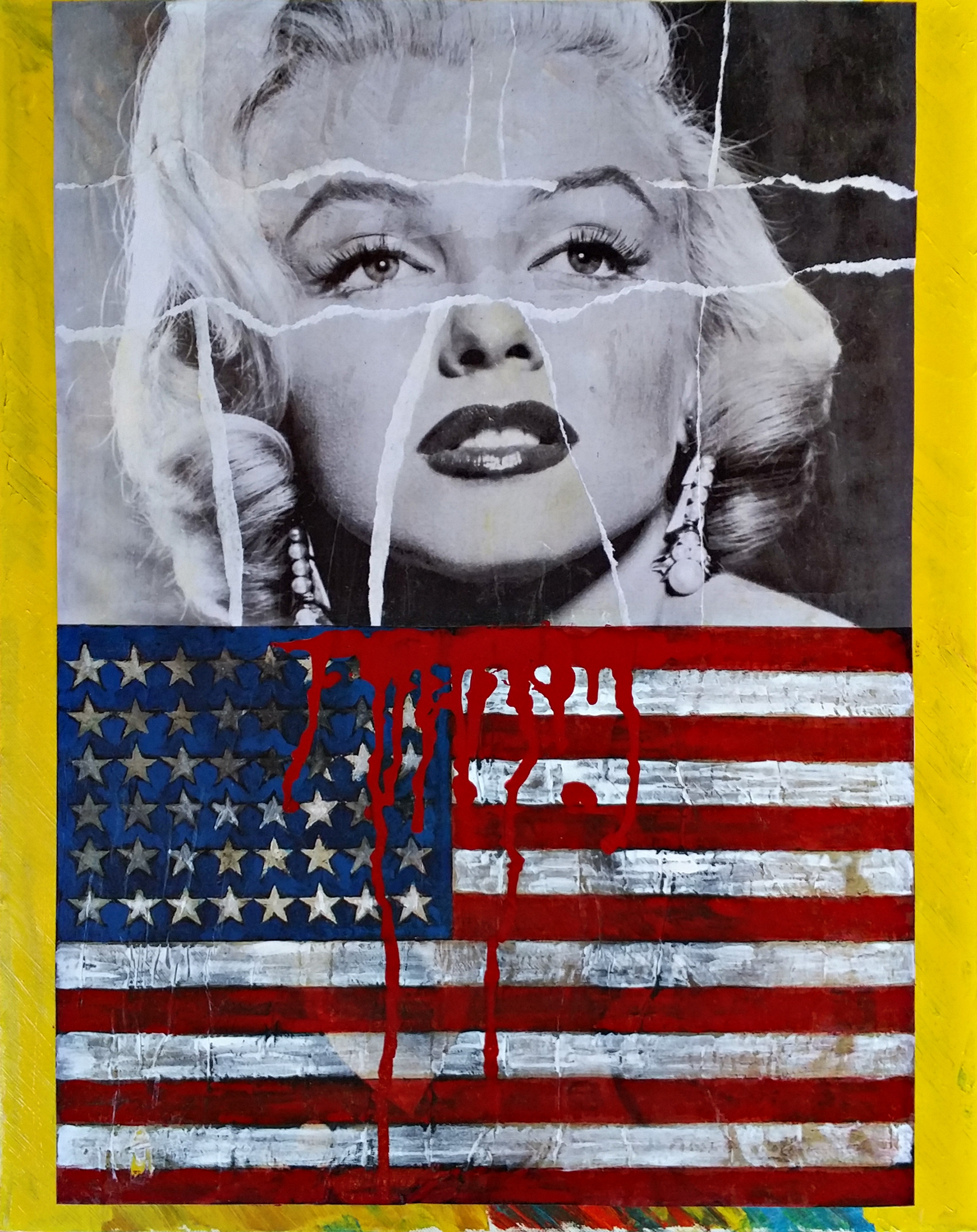
The portrait, seemingly classical in its frontal composition, is brutally interrupted by the American flag cutting horizontally across the work, dividing the visual field and, symbolically, the very life of the diva. The Stars and Stripes is not merely a patriotic backdrop here: it is a blade, a boundary, a device of power. Its line aligns with the throat, becoming an implicit gesture of iconographic decapitation. Blood — rendered in a pop key, chromatically saturated, almost graphic — spills onto the flag like an indelible stain, insinuating a silent accusation: the State is marked by this crime.
The connection to the Kennedy era is evident, yet not didactic. The flag does not represent only a nation, but a system of power — an interplay of political seduction, media spectacle, and image control. Marilyn, both muse and victim of that era, becomes here the sacrificial body of an America that devours its own female icons.
The cracks running across the face, created through paper lacerations, introduce a further level of interpretation. The face appears as a fractured ceramic surface — fragile, artificial. The icon, long perceived as perfect, reveals itself as a constructed object, a fragile pop relic destined to break. These fissures are not merely aesthetic marks, but metaphors for inner rupture, media pressure, and the split between person and persona. The diva is no longer a smooth, seductive surface: she is matter breaking under the weight of her own representation.
In this work, the artist performs an act of unmasking: pop culture is not only a celebration of the image, but also the site of its destruction. Marilyn is no longer simply the eternal diva, but the breaking point of an entire national narrative. The blood flowing across the flag is not merely a dramatic gesture: it is a political sign, a visual trace of collective guilt inscribed within the American myth.